Squeaky Hardwood Floors: Is It the Season or the Subfloor?
Published on
A squeaky hardwood floor usually has more in common with a creaky stair tread than with a cracked foundation. The noise is wood rubbing on wood, or a board sliding up and down a loose nail, every time your weight passes over it.
In most houses the squeak comes from one of two places: boards rubbing against each other as they swell and shrink with the seasons, or a subfloor that has pulled away from the joist beneath it. Most squeaks are harmless; a squeak that comes with a soft, bouncy or sinking spot is the one to have checked.
Which of the two you have decides the repair, and three quick questions usually tell them apart.
Seasonal or structural? Three questions that sort most squeaks
Do squeaky floors mean structural damage? Usually not. The American Hardwood Information Center, an information site run by the hardwood industry, puts most squeaks down to the normal yearly cycle of wood shrinking in dry months and swelling in humid ones, rather than to defects in the wood or poor workmanship.
Three questions narrow it down quickly:
- When does it squeak? A noise that shows up in one season and fades in the next points to the wood moving. One that is there all year, and louder every year, points to something loose underneath.
- Where is it? A single board or one seam is usually the boards or a fastener. A line of squeaks across the room often follows a joist. A whole area that creaks deserves a closer look.
- What does it feel like? If the floor feels firm and only makes noise, the problem is friction. If it gives, bounces or dips when you step on it, something below the boards is moving more than it should.
A firm floor with a seasonal squeak is a nuisance. A floor that moves underfoot is a repair, and sometimes a structural one.
Where the sound starts, one layer at a time
A nailed hardwood floor is a stack: the finished boards, the fasteners that hold them, a subfloor of plywood, OSB or, in older houses, wide boards, and the joists that carry it all. A squeak is two of those layers moving against each other. From the top down:
Board rubbing board
Tongue-and-groove boards are fitted tight, edge to edge. When the wood takes on moisture it swells, and the edges press and rub as you walk across them. When it dries out, fine gaps open and the boards have a little room to shift.
This is the seasonal squeak: short and sharp, from one seam, and often worse at one time of year.
A board sliding on its nail
Each board is held down by nails or cleats driven through its tongue into the subfloor. After years of seasons and foot traffic, some of them lose their grip, and the board rides up and down the fastener with each step.
Unlike the seasonal kind, this squeak repeats at exactly the same spot all year. Wagner Meters, a maker of moisture meters for flooring installers, lists inadequate nailing among the usual causes of squeaky floors.
Subfloor lifting off the joist
Below the boards, the subfloor should sit tight on top of every joist. If the nails holding it have loosened, or the panels are too thin for the joist spacing, a small gap opens, and every step closes it again. The result is a duller creak that can run in a line across the room.
The rest of Wagner’s list adds subfloors that flex underfoot or are simply too thin, flooring nailed onto particleboard, and boards laid in the wrong direction relative to the joists.
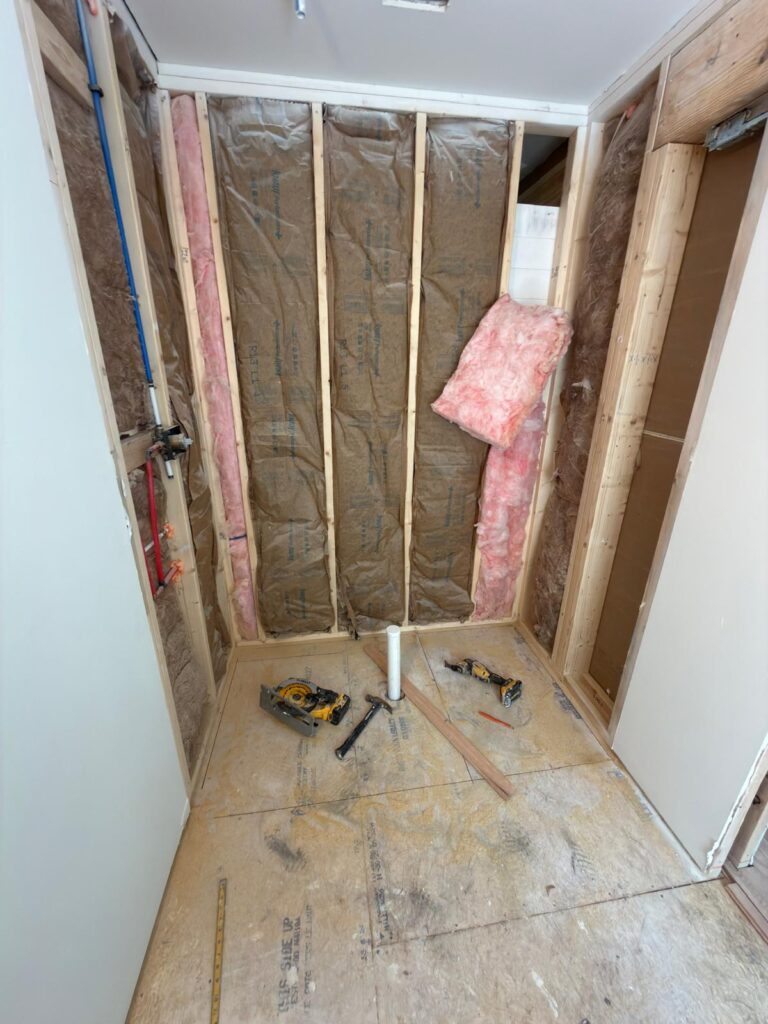
This bathroom, from our Full-Home Remodel project, was opened down to the subfloor. Every finished floor rests on a layer like this one, and it is the layer most squeak repairs end up dealing with.
Joists that flex
The joists are the bottom layer, and the one that turns a squeak into a structural question. A joist weakened by rot or insect damage, one that was notched for a pipe or a duct, or framing that is undersized for its span will flex more than its neighbors.
The floor above bounces, sags or slopes, and the squeak is a symptom rather than the problem.
Why Lowcountry floors squeak on a schedule
Charleston gives a wood floor two seasons to react to. Through the long, humid summer the house relies on its air conditioning to pull moisture out of the indoor air, and the boards absorb whatever it leaves behind.
In winter, the heat dries the air and the same boards give some of that moisture back. Seams that were tight in August can be loose by January.
Many older houses here also sit over a crawl space rather than a slab. Whatever the air is doing down there, the subfloor and the joists feel it first. Damp air under the house keeps the framing moving from season to season, and framing that stays wet for long stretches is at risk of rot.
Old heart pine adds one more variable. As our hardwood flooring page puts it, the wood is dense and hard, yet decades of sanding leave the boards thin, so any repair through the face of them calls for a careful hand.
For prevention, the hardwood center recommends the same thing anywhere: keep indoor humidity as steady as you can all year. And when the underside of the boards gets wetter than the top, the same moisture shows up as cupped boards instead of noise, which is a separate problem with its own order of repairs.
How a flooring contractor quiets each kind of squeak
Can you fix squeaky floors without removing flooring? In almost every case, yes. The work happens either from above, through the finished floor, or from below, from a crawl space or an unfinished basement. Which one fits depends on the layer that is moving and on what is under the floor.
| Where the squeak comes from | What a contractor usually does | Access needed | What it leaves on the floor |
|---|---|---|---|
| Two boards rubbing at a seam, mostly in one season | Works a dry lubricant, such as powdered graphite or talc, into the seam, or waits for the season to turn | None beyond the room | Nothing visible; the squeak can return |
| A board loose on its nail | Refastens the board to the subfloor with pre-drilled finish nails or trim screws, heads set below the surface | From the room | Small filled holes, matched to the floor color |
| Subfloor pulled away from a joist, with a crawl space or open basement below | Closes the gap from underneath with glued shims, screws through the side of the joist, or a block fastened alongside it | Crawl space or basement | Nothing; the finished floor isn’t touched |
| Subfloor pulled away from a joist, with a finished ceiling or no way underneath | Finds the joist and drives screws through the floor into it, using screws designed to snap off below the surface | From the room | A few small filled holes |
| A split or damaged board that moves | Cuts the board out and weaves a new one into the surrounding floor | From the room | A patch that blends in best after the room is refinished |
| Bouncing, sagging or sloping floor | Opens up and inspects the subfloor and framing; the joist repair comes first, usually by a framing contractor or a structural engineer | From below, or by opening the floor | Depends on the structural repair |
Most of the fixes from above and from below are methods the American Hardwood Information Center describes.
Board replacement is where our own work comes in. Cutting out split, cupped or water-damaged boards and fitting new ones is part of our hardwood floor repair work, and in an old floor a patch seldom disappears entirely until the whole floor gets a fresh finish.
If a sanding is on your list anyway, have the squeaks fixed first, so filled fastener holes go under the new coats instead of sitting on top of a fresh finish. Bring it up when you ask about hardwood floor refinishing.
New floors that squeak within months of installation are a different case. Wagner points to the start of the job for many of them: wood and subfloor that weren’t at matching moisture levels when the boards went down, a thin or springy subfloor, or too few fasteners.
It is the reason our flooring installations begin with the subfloor, checked for flatness and moisture before any material goes down.
What not to do with a squeaky floor
- Will WD-40 stop floors from creaking? Don’t count on it. An oil can’t tighten a loose nail or close a gap at the joist, and it isn’t among the fixes the hardwood center lists: its lubricants are dry powders, and it limits even liquid wax to floors with a wax finish, not urethane or varnish.
- Hammering a shim in hard backfires. A shim forced into the gap between subfloor and joist lifts the boards above it and can leave a hump or open a new gap.
- Nailing through the face of old heart pine isn’t a quick fix. Without a pilot hole the board can split, which is why the hardwood center calls for pre-drilling, and a board sanded many times has less wood left to hold a fastener.
- Sanding won’t get rid of a squeak. It changes the surface, not the fasteners or the subfloor, and every pass spends wood an old floor can’t get back.
- Blind screwing from a crawl space is how floors get punctured. A screw longer than the subfloor and flooring combined comes out through the face of the floor, and wiring, pipes and ductwork often share the space between joists.
What moves the price of a squeak repair
How expensive is it to fix squeaky floors? It depends more on how many spots there are, and which layer each one comes from, than on the size of the room. The factors that move the number:
- Access. An open crawl space makes repairs from below simpler; a finished ceiling, or no way underneath, means working through the floor.
- Number and spread. One seam in a hallway is a different job from squeaks across a whole level.
- Finish work. Repairs through the face of the floor need filling and color-matching, and sometimes a refinish to blend them.
- Boards to replace. Species, width and age decide how hard the match is.
- What’s underneath. A loose subfloor is flooring work; damaged joists bring in framing work and possibly other trades.
We don’t put a number on a repair we haven’t seen. We look at the floor and the subfloor first, and the written estimate spells out the repair and any finish work instead of burying them in one line. The visit is free.
Squeaks that need a professional look now
Most squeaks can wait for a convenient week. These shouldn’t:
- Stepping on the squeaky spot makes the floor give, bounce or dip.
- The floor now slopes where it used to be level, or a door that used to clear it now drags.
- The squeak started after a leak or a flood, or the crawl space smells musty or has standing water.
- Tile set on the same floor, or the ceiling below it, has started to crack.
- Boards near the squeak are cupping, lifting or pulling apart.
- Squeaks turn up in many places on a floor installed within the last year.
- The noise spreads or gets louder from one year to the next instead of coming and going with the seasons.
Any one of these says the movement is below the boards. If you’re seeing it, request a hardwood floor repair estimate, and we’ll find which layer is moving and tell you whether the fix is flooring work, framing work or both.
Keep reading