Refinish vs Replace Hardwood Floors: How to Decide
Published on
A hardwood floor that looks ruined can be the easiest floor in the house to save, while one that looks fine can be too thin to sand again. Appearance is a poor guide; what decides between refinishing and replacing is where the damage stops and how much wood is left above the tongue.
Refinish when the damage is in the finish or the top of the wood and the boards still have thickness to give. Replace when they’ve been sanded thin, when water has damaged the boards or the subfloor beneath them, or when an engineered floor’s top layer is too shallow to sand.
What each kind of damage usually needs
The National Wood Flooring Association sorts floor damage into a few groups, and each points to a different fix. The fingernail test in the first row is theirs: if your nail can’t feel the scratch, it’s only in the finish.
| What you see | What the NWFA says it may need | Refinish or replace? |
|---|---|---|
| Dull floor, fine surface scratches your fingernail can’t feel | A maintenance coat: clean, lightly abrade, apply fresh finish | Neither: a new coat may be enough |
| Deep scratches through the finish, gray traffic lanes where the finish is gone | A complete sand and refinish | Refinish |
| Dents and gouges | Isolation repair, resanding, or replacing the affected boards | Usually refinish, plus a few new boards |
| Stains such as pet urine or chemical and moisture spills | Often resanding and/or replacing the affected areas | Depends on how deep the stain goes |
| Water damage, from slight cupping to buckling | Case by case, after checking the moisture of the floor, the subfloor and the room | Diagnose first; replacement only if boards or subfloor are ruined |
Both columns come from the NWFA: its homeowner page on refinishing and the repair chapter of its 2025 Installation Guidelines.
A decision path, one question at a time
- Does your fingernail catch on the scratches? If not, the damage is in the finish. A maintenance coat is the next step, not sanding.
- Is the damage in the wood? Deep scratches, worn-through traffic lanes and shallow stains come out with a full sanding, as long as there’s wood to spare.
- How much wood is left above the tongue? Look at a board’s edge where it shows: at a floor register, a threshold or the top of a stair. If earlier sandings have taken the top close to the tongue, another one can’t go deep enough, and that floor is a replacement candidate.
- Is it engineered? Then only the top wood layer can be sanded, and its thickness, not the board’s, sets the answer. Some thin engineered products can’t take a sanding at all.
- Did water get under it? Find and dry the source before anything else. Cupping that comes from moisture below can settle once the cause is fixed; sanding too early can leave a new problem, as our article on hardwood floor cupping explains.
- Does the floor bounce, dip or squeak? That’s the structure or the subfloor, and no finish fixes it. Flatness and stiffness come first; our guide to leveling subfloor before flooring covers the checks.
- Is the damage limited to a few boards? Replace those boards, then refinish the whole room so the patch blends in. In an old floor, a repair rarely disappears unless the whole floor is refinished afterwards.
- Do you want a different color? A full sanding takes the floor back to raw wood, which the NWFA calls the right moment to change color. You don’t need new boards for a new look.
The NWFA adds a caution worth knowing before any estimate: how many times a floor can be sanded depends on the skill of the contractor, the equipment, the thickness of the wear layer, the flatness of the floor and its condition. In other words, the same floor can allow more or fewer sandings depending on who sands it and how.
Floors from our projects, before and after sanding
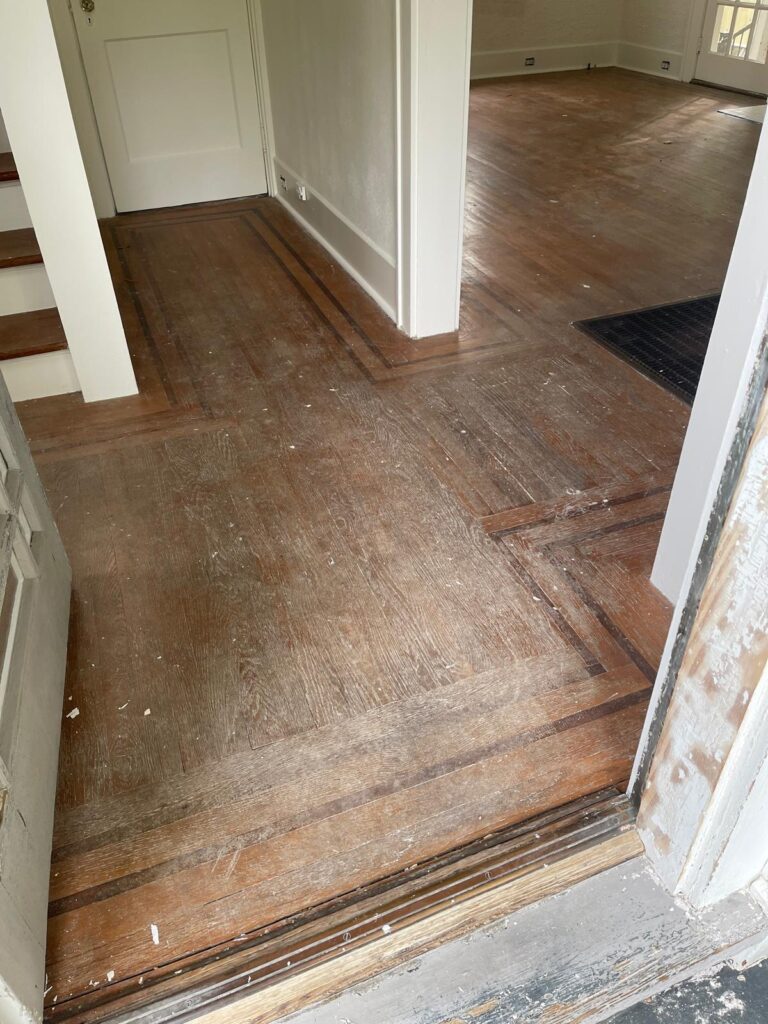
This floor, from our Whole-Home Renovation project, had a dull, scuffed surface and a border inlay running around the room. Damage like this sits in the finish and the top of the wood, which is what sanding removes, and the border is the kind of detail that’s hard to reproduce in a new floor.
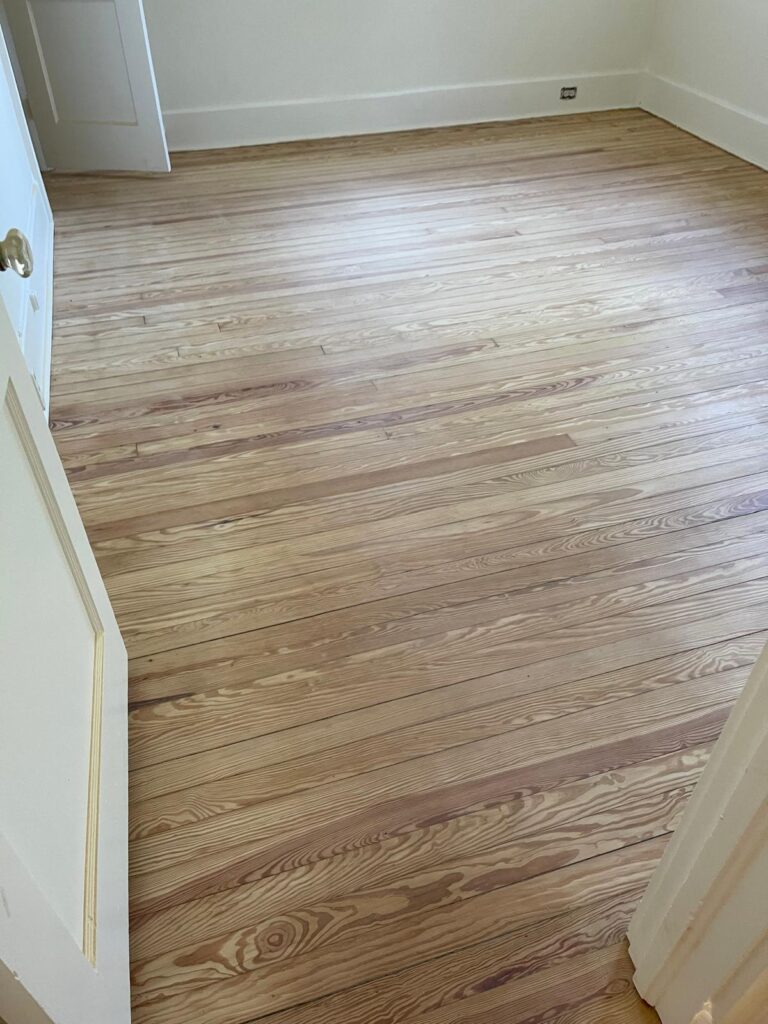
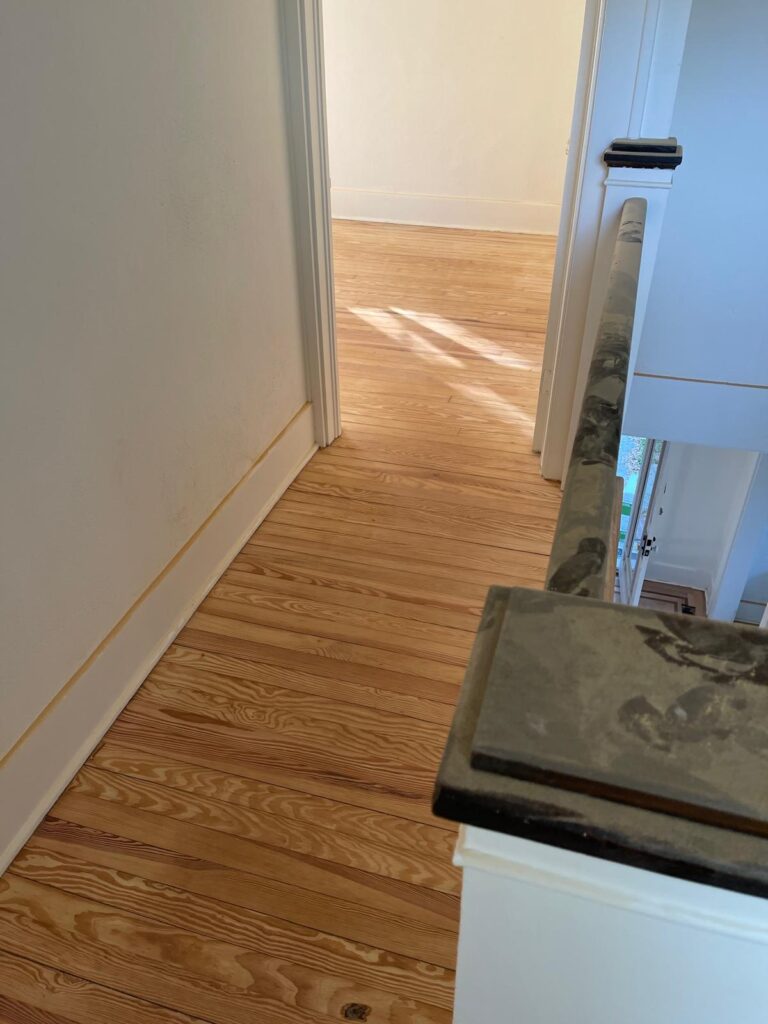
Another room in the same project after sanding: the old finish and the surface wear are gone, and the grain is ready for stain or a clear finish. This is the stage where a color change happens.
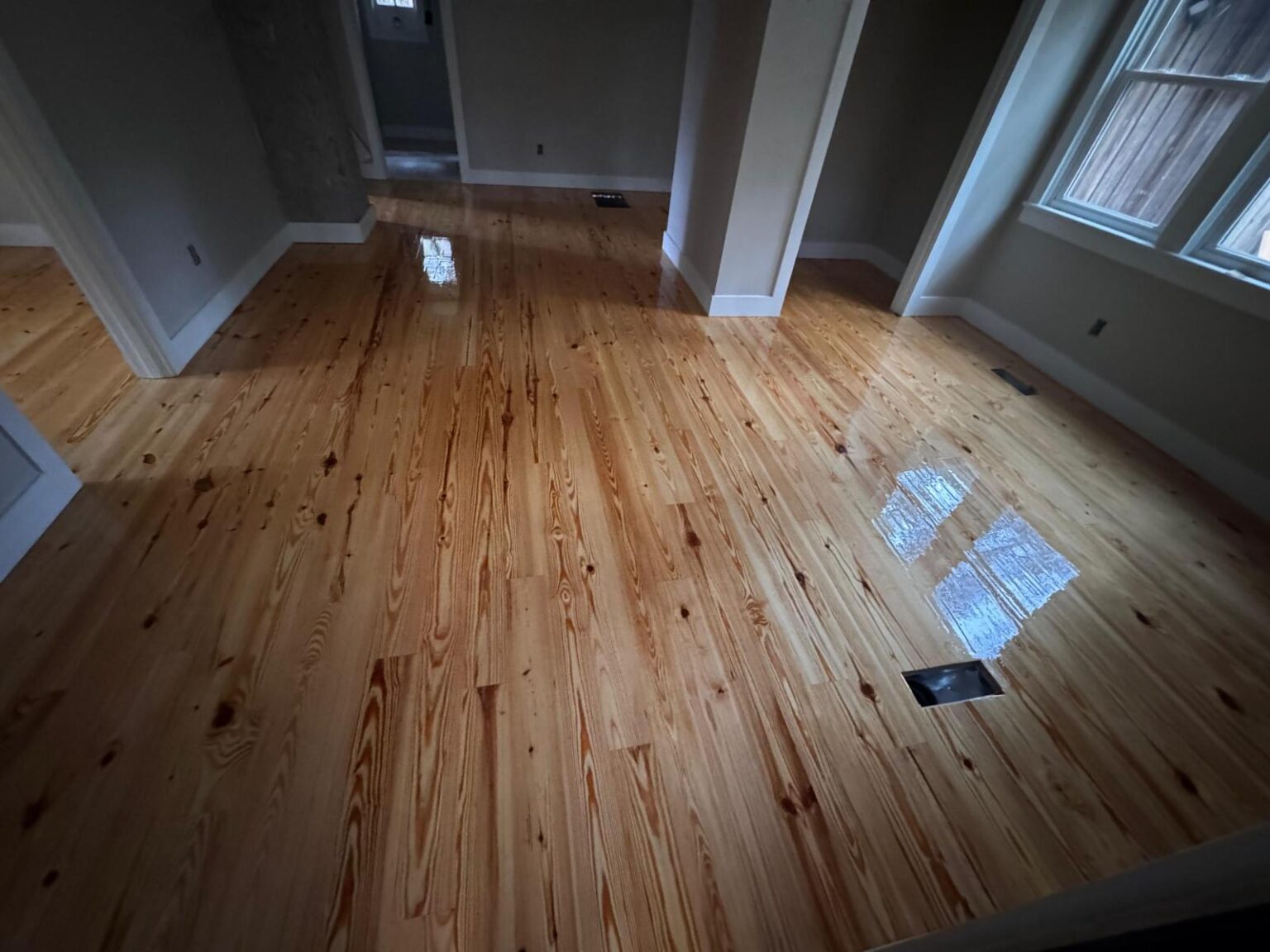
The featured image shows where that road ends: refinished pine with a fresh coat of finish, from our Full-Home Remodel project, where heart-pine floors were refinished rather than replaced.
Older floors and painted floors
Older floors bring two extra checks. The first is thickness: a floor that has been refinished several times over its life, as many old pine floors have, has less left to give, so the next sanding has to be lighter and the edges handled with more care.
If a floor was ever painted and the house was built before 1978, sanding that paint falls under the EPA’s lead-safe renovation rules, and the firm doing it needs RRP certification (EPA Renovation, Repair and Painting Program). That doesn’t rule out refinishing; it changes how the work is done.
Beyond the boards: time, height, matching and cost
- Time out of the room: both options empty the room. Refinishing adds drying and curing time for the finish, which varies a lot between products, so ask for the cure times of the finish being used before the work starts.
- Height: refinishing keeps the floor where it is. A replacement floor can sit higher or lower than the old one, which affects doors, thresholds and the transition to the next room.
- Matching: refinishing keeps one floor running through connected rooms. Replacing one room raises the question of whether the new boards will match the rest of the house.
- Cost drivers: a refinish is priced mostly by area, then moved by repairs and board replacements, stain or a color change, the number and type of finish coats, and stairs, borders or inlays. A replacement adds tear-out and haul-away, any subfloor work, the new material and the transitions at every doorway.
At the visit we look at the finish, the board edges and the subfloor, and the answer goes into a written estimate with prep, material and finish itemised. Start with our hardwood floor refinishing in Charleston page; if the boards are past saving, see our hardwood floor installation work.
Keep reading