Best Tile for Shower Walls: Porcelain, Ceramic, Stone or Glass?
Published on
For most showers, the best tile for shower walls is glazed porcelain: by the industry definition it absorbs 0.5% of water or less, it shrugs off stains, and it comes in every size from small subway to near-slab panels. Glazed ceramic wall tile is a sound, easier-to-cut alternative on walls.
Natural stone and glass both work too, with more care. Whatever you pick, the wall behind the tile decides how long it lasts as much as the tile does.
Shower wall tile materials compared
The Tile Council of North America defines porcelain as tile with water absorption of 0.5% or less; anything above that is non-porcelain. It also warns that some tile sold as porcelain doesn’t meet that standard, and that the Porcelain Tile Certification Agency (PTCA) mark identifies tile certified as true porcelain (TCNA, porcelain vs. non-porcelain).
| Material | Water absorption | Upkeep on a shower wall | Best for | Watch out for |
|---|---|---|---|---|
| Glazed porcelain | 0.5% or less by definition | Low: wipe down, keep grout clean | Any shower, including large formats | Harder to cut and to bond; large pieces need a very flat wall |
| Glazed ceramic (non-porcelain) | Above 0.5%, behind a glazed face | Low | Walls, subway and pattern tile, budgets | Check the maker’s rating; wall-only tile doesn’t belong on a floor |
| Natural stone (marble, travertine) | Porous; varies by stone | Higher: sealing on a schedule, gentle cleaners | A classic look, accent walls | Stains and etching; tight joints and unsanded grout |
| Glass | Practically impervious | Low | Accents, niches, bands | Setting materials must be the ones the glass maker specifies |
TCNA also notes that non-porcelain tile is generally easier to bond and to cut, which matters on walls with many niches and edges. On stone, it’s specific about grout: marble is usually set with 1/16-inch joints, and sanded grout should never go on marble or any surface the sand can scratch (TCNA on grout).
How tile size and layout change the wall
The bigger the tile, the flatter the wall has to be. A large tile spans every dip and hump in the backer, and its edges show it.
TCNA points out that when tile is set over an uneven substrate, the finished surface won’t meet the industry’s lippage standard, the limit on how far one tile edge can sit above the next (TCNA on lippage).
Small tile works the other way. It follows curves, wraps niches and benches, and forgives an imperfect wall, but it means more grout joints to keep clean.
- Subway and elongated tile: forgiving, classic, and easy to lay out around a valve and a niche. Stacked vertically, it can make a low ceiling feel taller.
- Large format (12-by-24-inch pieces and up, all the way to 24-by-48): fewer joints and a calmer wall, but heavier pieces, more precise prep and careful cuts at the niche and the valve.
- Picket, hexagon and other shapes: the pattern carries the room, so the layout has to be planned from the center line before the first tile goes up.
- Mosaic: best as an accent, a niche or a band; across a whole wall it’s a lot of grout.
The grout is chosen by the joint width: below 1/8 inch, TCNA’s guidance is unsanded grout; at 1/8 inch and wider, sanded. Your installer sets the joint width from the actual size variation of the tile you buy.
Shower walls from our own jobs, and why each one works
These are showers we tiled. Each one shows a different answer to the same question.

Large marble-look tile in a corner shower. Big rectangles laid in an offset pattern keep the joints to a minimum, and the niche is framed so its cut edges don’t show.
A wall like this only works when the backer is flat, which is why the prep comes first: this is the same shower shown at the waterproofing stage in our article on why shower tiles crack.

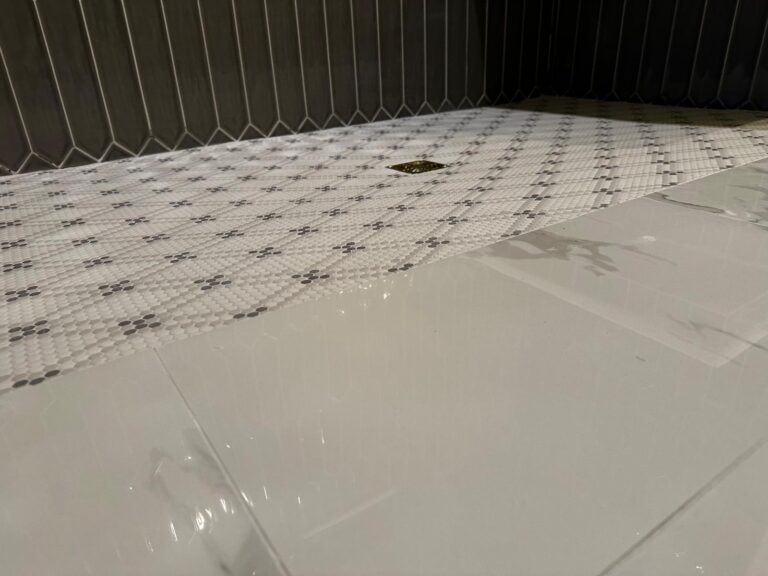
Two wall tiles split at a line. Glossy elongated tile stacked vertically on the upper walls, a larger speckled tile on the lower third, and a pebble floor.
Splitting the wall at a line lets two tiles share the job: a busy speckled pattern low, where water spots are less obvious, and a glossy tile above, stacked so it draws the eye up.
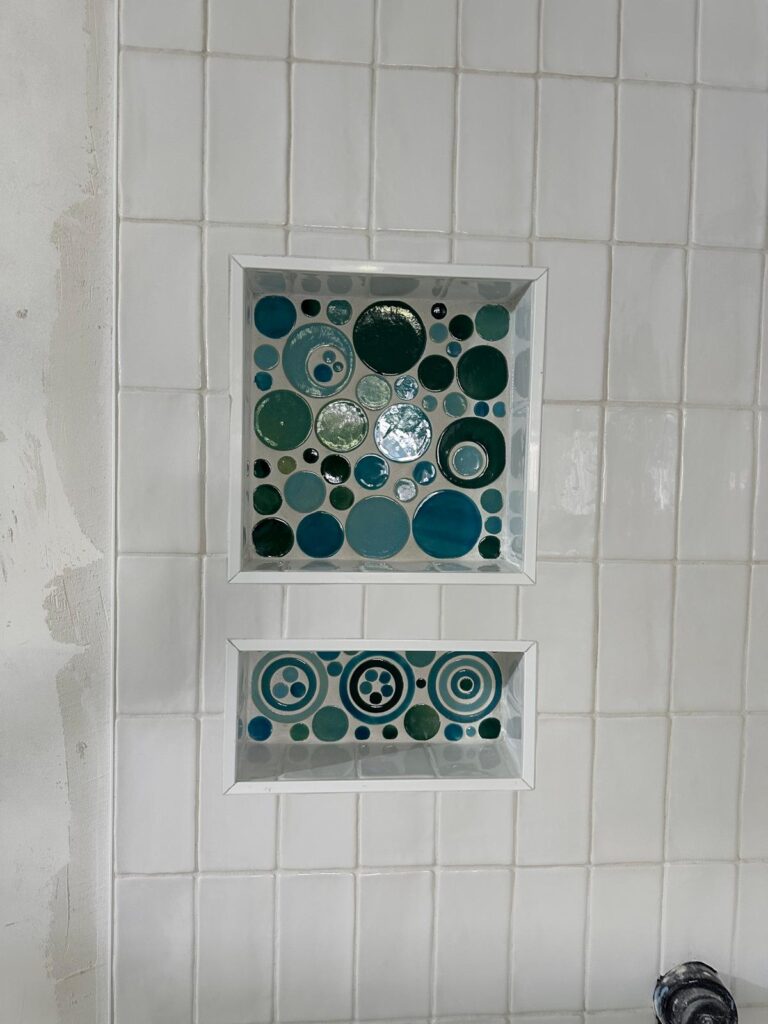
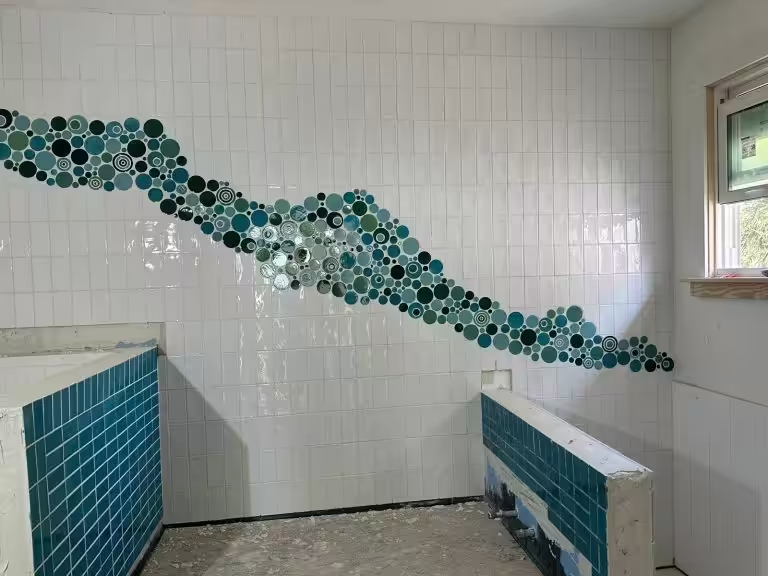
Glass as the accent, not the wall. Two niches lined with round glass mosaic inside a plain white field. Glass brings the color; the white tile around it keeps the wall easy to live with.
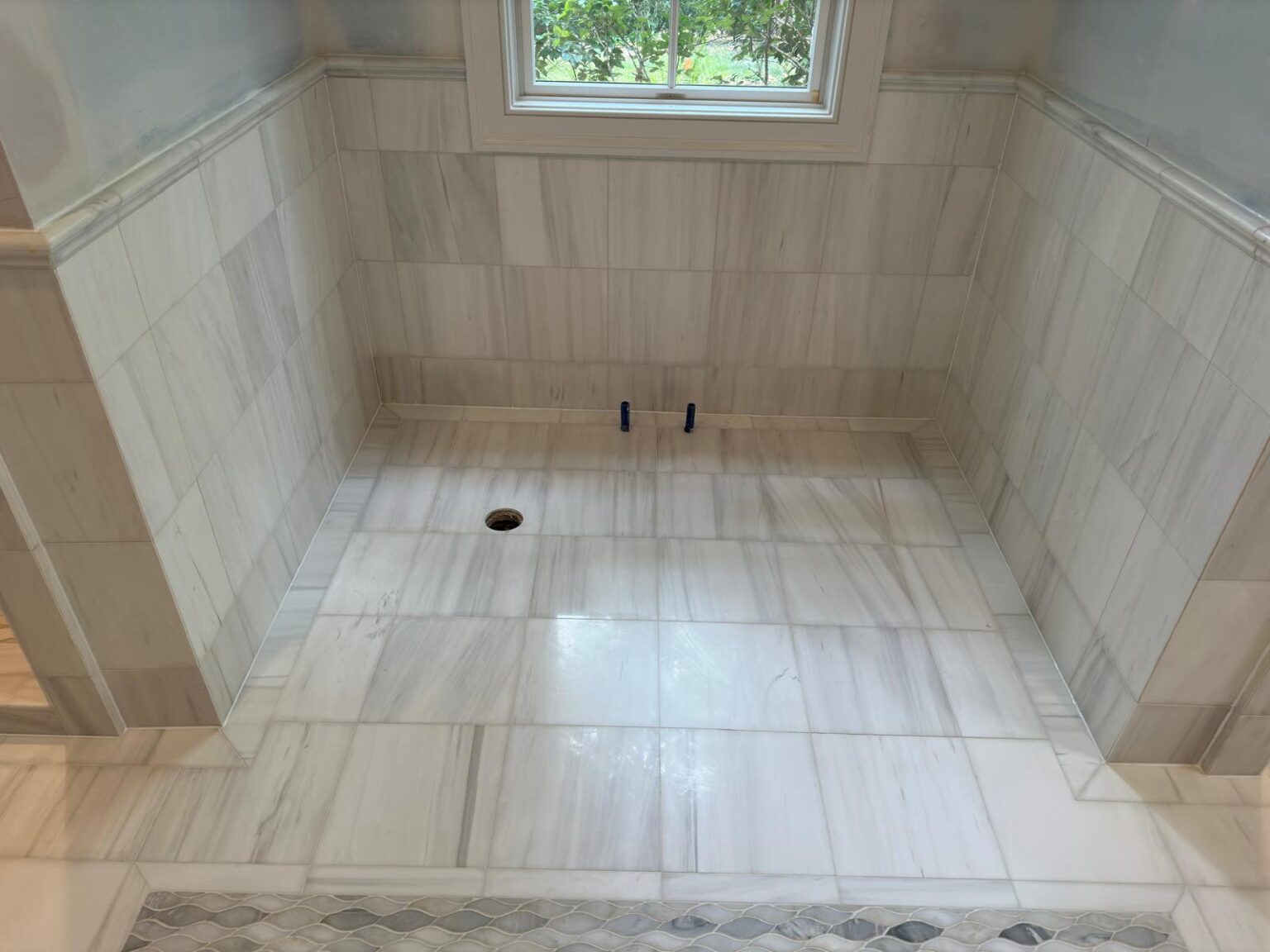
The photo at the top of this article shows a fourth answer: large stone-look tiles running up the walls of a walk-in shower to a molded cap under the window, with the same tile on the shower floor. Few joints, one material, and a wall that had to be flat for it to work.
Shaped tile such as picket or hexagon goes the other way: the pattern is the whole design, so its layout has to be planned from the center line before the first piece goes up.
What has to be behind the tile
Grout isn’t waterproof, so the tile is the finish, not the barrier. The 2021 International Residential Code, the basis of South Carolina’s residential code, asks for a nonabsorbent surface on shower walls to at least 6 feet above the floor (R307.2, IRC 2021, Chapter 3).
It also lists which boards may go behind wall tile in showers and over tubs: glass-mat gypsum, fiber-reinforced gypsum, fiber-cement and cementitious backer units, installed to their makers’ instructions (R702.4.2, IRC 2021, Chapter 7).
Over that goes the waterproofing: a membrane, or a waterproof board system with sealed seams. Get this layer wrong and even the best tile cracks or comes loose, which is why our shower tile installation work starts behind the wall.
The floor of the shower is a separate choice, with slip resistance in play; it usually calls for smaller tile than the walls.
Tile or a grout-free panel?
If you’re also looking at quartz, solid-surface or other “groutless” panel walls, the trade-off is simple. Panels have few or no joints to clean. There is no truly grout-free tile; the closest is large-format tile set with narrow joints.
Tile gives you far more choice of material, size and pattern, handles niches and benches naturally, and can be repaired one piece at a time.
Our shower work is tile and natural stone, usually as part of a full bathroom remodel, so that’s where we can help you compare options on site.
What changes the price of a tiled shower wall
The material is only part of it. Size and pattern change the labor a lot: a large-format wall goes up faster than a herringbone or picket layout of the same area, but it needs more precise prep. Niches, benches, the height you tile to, and the condition of the existing wall all add or remove hours.
That’s why our written estimates list substrate prep and waterproofing as their own lines, separate from the tile. If you’re choosing shower wall tile now, bring the samples you like to the visit and we’ll tell you what each one asks of your wall. Request it through our tile installation in Charleston page.
Keep reading